
Written by: Ameera Ali, RCC and CCC at Peak Resilience
Book a session with me | ameera.counselling@proton.me
Have you ever felt like different parts of you want completely different things?
Maybe one part of you wants to try something new, while another part is worried about what could go wrong. One part might tell you to keep pushing, while another is exhausted and wants to give up. You might even notice yourself reacting in a way that you don’t fully understand and think, “Why did I do that?”
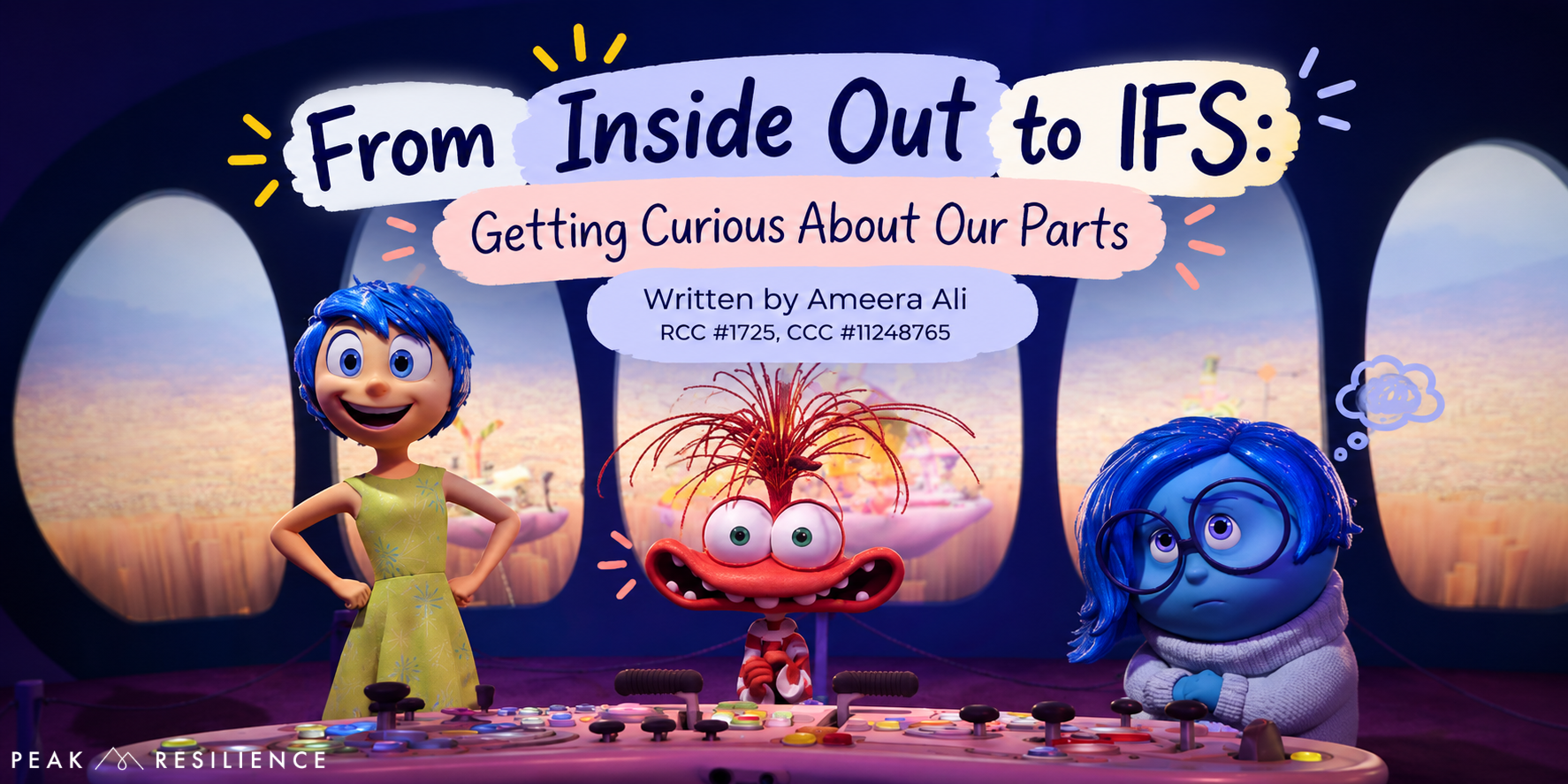
If you’ve seen the movie Inside Out, you may already have a sense of what this can look like. The movie gives us a glimpse into the world inside Riley’s mind, where different emotions influence how she experiences and responds to the world around her.
While Inside Out isn’t a perfect representation of Internal Family Systems (IFS), it offers a helpful way to think about one of the central ideas of IFS: we all have different parts of ourselves, and each part has a reason for being there.
By understanding what our parts are trying to do for us, we can begin to develop a more compassionate relationship with ourselves over time.
What is Internal Family Systems (IFS)?
IFS is a therapeutic approach developed by Richard Schwartz that views the mind as being made up of different “parts”, each with its own thoughts, feelings, and ways of responding. Having different parts is a normal part of being human.
You may notice a part of you that wants to be perfect, another that worries, another that gets angry, and another that wants to avoid difficult things. These parts can have very different roles, but they often have something in common: they are trying to protect us in some way.
IFS isn’t about getting rid of parts or changing who you are. Instead, it is about noticing these different parts, recognizing what shaped them, and learning how to respond to them with care.
Understanding IFS Therapy through Inside Out
Inside Out gives us a simple way to picture the different emotions and experiences happening inside our minds. In the movie, we see how different emotions influence Riley’s thoughts, memories, and actions.
Although the emotions in Inside Out aren’t the same as IFS parts, the movie can help us picture what it might feel like to have different parts responding to the same experience. Sometimes one part can become especially loud when we’re stressed, scared, hurt, or overwhelmed.
This is similar to what we can explore in IFS therapy: If we think about our inner world like a team, who is doing what?
Meet the Managers, Firefighters, and Exiles
In IFS, parts are often described as belonging to three groups: managers, firefighters, and exiles.
Managers are the parts of us that like to stay one step ahead. They try to prevent pain before it happens by keeping us prepared, in control, or out of trouble. They can show up in behaviours that reflect perfectionism, people-pleasing, overthinking, or being extremely hard on yourself.
If we look at the characters in Inside Out, Fear and Disgust can be useful analogies for some manager parts. Fear tries to prevent Riley from being hurt or making mistakes, while Disgust helps protect Riley from rejection, embarrassment, or things she sees as unsafe.
Firefighters are our reactive protectors. They tend to show up when emotions become overwhelming, with the goal of making the difficult feeling go away as quickly as possible. They may show up as avoidance, distraction, shutting down, anger, or impulsive behaviours.
Anger is an excellent example from Inside Out. When Riley feels hurt, powerless, or frustrated, Anger steps in to protect her. Firefighter parts don’t always stop to ask whether their response will be helpful in the long run. Their priority is putting out the emotional fire in the moment.
Exiles are parts that carry painful emotions and experiences. These parts may hold feelings such as sadness, shame, loneliness, fear, or rejection. Often, other parts of us work hard to protect these vulnerable parts from being hurt again.
Sadness in Inside Out can be a helpful analogy here. She represents some of the painful emotions that we may want to push away, even though those feelings are an important part of our experience.
There Are No “Bad” Parts
One of the biggest takeaways from IFS is that we don’t have to label our parts as “good” or “bad.” A behaviour can be unhelpful while the intention behind it is protective. Below are some common examples:
- Perfectionism → “If I do everything perfectly, I won’t be criticized.”
- Anger → “If I get angry, I don’t have to feel hurt.”
- Avoidance → “If I don’t try, I can’t fail.”
- People-pleasing → “If everyone is happy with me, I won’t be rejected.”
Instead of asking, “How do I get rid of this part?” we can ask, “What is this part afraid might happen if it stopped doing its job?”
This brings us to another important part of IFS: Self.
Self is different from our parts. It is the part of us that can approach our inner experiences with qualities such as curiosity, compassion, calm, clarity, courage, confidence, and connection. When we are in Self, we don’t have to fight with our parts or silence them. We can listen to them and understand what they need.
How IFS Therapy Helps Us Get Curious About Our Parts
So, how can we explore our parts, both inside and outside of sessions?
Ted Lasso says it best: “Be curious, not judgemental.”
Instead of judging ourselves when we feel anxious, angry, or stuck, we can ask, “What part of me is feeling this way?” We might then wonder, “What is this part worried might happen?” or “What is it trying to protect me from?”
For example, if you notice a part of you becoming very critical after making a mistake, you might get curious about what that part is afraid would happen if you weren’t perfect. Maybe it believes that being perfect will keep you safe from criticism or rejection.
This doesn’t mean we have to agree with everything our parts tell us or continue behaviours that aren’t helpful. Instead, curiosity gives us a chance to understand where our reactions come from rather than immediately judging ourselves for having them.
Over time, getting to know our parts can help us feel less controlled by them and more connected to what we truly need. Sometimes, understanding ourselves doesn’t begin with changing who we are. It begins with getting curious about why we respond the way we do.
If you find yourself noticing patterns, reactions, or inner conflicts that you would like to explore further, counselling can provide a supportive space to slow down, better understand what is happening beneath the surface, and develop a more compassionate relationship with yourself. You don’t have to figure it all out on your own. You can learn more about my approach to counselling here or book a session with me!


